
Artificial intelligence is becoming an increasingly important part of Starbucks’ long-term strategy, but like many large companies, the coffee chain will ultimately be judged on whether those investments translate into stronger financial performance.
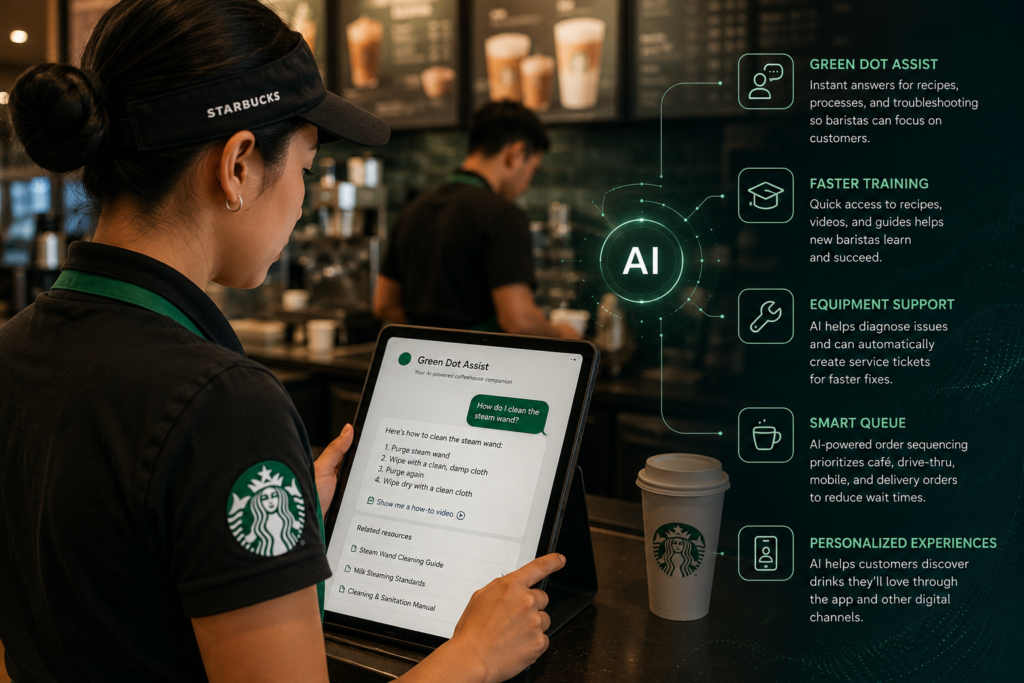
Rather than focusing on flashy customer-facing features, Starbucks has directed much of its AI effort toward improving day-to-day store operations. The company’s recently introduced Green Dot Assist, built using generative AI, acts as a digital assistant for baristas. Available on in-store iPads, it allows employees to ask questions in natural language about drink recipes, ingredient substitutions, operating procedures, cleaning tasks, and equipment troubleshooting, helping them find answers in seconds instead of searching through manuals.
The technology is also expected to simplify training for new employees by providing instant guidance and instructional resources, potentially reducing onboarding time while giving baristas greater confidence behind the counter. Starbucks has also outlined plans for Green Dot Assist to help identify equipment problems and automatically initiate maintenance requests, reducing downtime when critical machines require service.
Beyond employee support, Starbucks is testing AI-powered workflow tools designed to improve the speed and consistency of order fulfillment. One initiative, known as Smart Queue, uses artificial intelligence to prioritize drinks from the café, drive-thru, mobile orders, and delivery services in a way that keeps beverages flowing more efficiently during busy periods. The company is also exploring AI-driven personalization through its mobile app, helping customers discover drinks tailored to their tastes and preferences.
These initiatives reflect a broader shift in how Starbucks views artificial intelligence. Rather than replacing employees, the company has emphasized using AI to remove routine tasks, reduce operational friction, and allow baristas to spend more time engaging with customers and crafting beverages.
Still, these innovations come with significant costs. Developing, deploying, and maintaining AI systems requires ongoing investment in cloud computing infrastructure, software development, cybersecurity, and technical talent. As enterprises across multiple industries increase AI spending, investors are paying closer attention to whether those technologies deliver measurable returns.
For Starbucks, the payoff could come through faster service, improved labor efficiency, reduced equipment downtime, and a smoother customer experience. If those operational gains outweigh the ongoing costs of AI development, the technology could become a meaningful contributor to the company’s long-term margins. If not, it risks becoming another expensive layer of operating costs in an already competitive retail environment.
As AI adoption continues to accelerate, Starbucks’ approach may serve as an early test of whether practical, employee-focused artificial intelligence can deliver lasting value—not just through innovation, but through measurable improvements to everyday operations.
One Comment