Last week, we explored how Starbucks is using artificial intelligence to improve store operations and support partners behind the counter. This follow-up looks at the other side of that conversation: the human connection Starbucks still wants at the center of its coffeehouse experience.
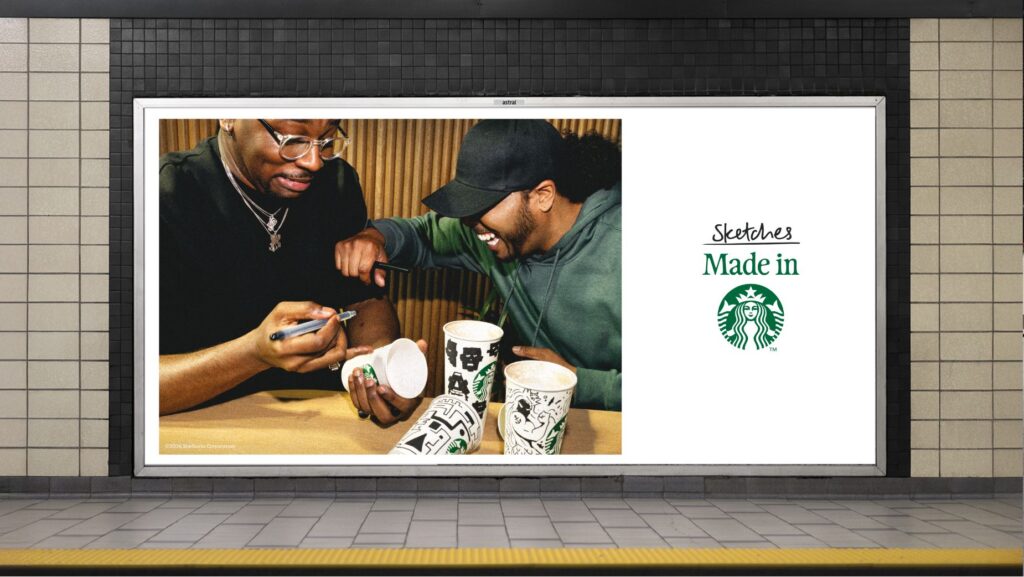
A recent interview with Starbucks UK Marketing Director Vic Robertson, published by Little Black Book, offers a closer look at the thinking behind the company’s new “Made in Starbucks” campaign. Rather than building the campaign around a product launch or digital innovation, Robertson and his team focused on something much more familiar: the real conversations, creative work, and everyday connections already happening inside Starbucks locations across the UK.
The campaign, created by Anomaly, is built around the idea that creativity often depends on being together in person. According to LBB, Starbucks UK used recent research showing that many Millennials and Gen Z consumers still view face-to-face connection as essential to creativity. At the same time, many feel that welcoming public spaces for those interactions are becoming harder to find.
That insight gave Starbucks a natural starting point. Instead of trying to invent a new brand message, the campaign highlights how customers already use Starbucks coffeehouses: to study, sketch, meet collaborators, work on side projects, write, build businesses, and simply spend time together over coffee.
“Made in Starbucks is a celebration of something that already exists.”
That line from Robertson captures what makes the campaign feel especially effective. Starbucks is not claiming to manufacture creativity. It is positioning its stores as places where creative energy, ambition, and connection can naturally unfold. That is a subtle difference, but an important one.
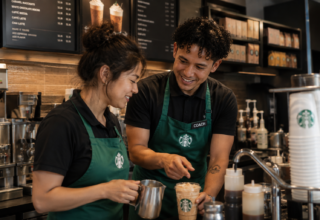
Many brands talk about community in broad terms. “Made in Starbucks” works because it appears to be rooted in observed behavior rather than polished advertising fantasy. The campaign features real customers, real baristas, and real creatives, giving the work a documentary-style quality instead of relying on staged, overly perfect scenes.
Robertson told LBB that this choice was intentional. The campaign was built around real communities and real behaviors, with the goal of capturing what is already happening inside Starbucks coffeehouses. That approach gives the work a more grounded, human feel and helps reinforce Starbucks’ long-running role as a “third place” between home and work.
For years, Starbucks has tried to be more than a place to buy coffee. Its stores have functioned as meeting points, study spaces, workspaces, and casual gathering places. The “Made in Starbucks” campaign leans into that identity by showing how meaningful moments can begin with something as simple as a conversation at a table.
That message feels especially relevant at a time when many companies are leaning heavily into automation, apps, and AI-driven experiences. Starbucks may be investing in technology to make operations faster and more efficient, but this campaign is a reminder that efficiency is not the same thing as connection.
The strongest coffeehouse experiences are often built around small human moments: a first meeting between collaborators, a study session that turns into a milestone, a conversation that sparks a new idea, or a familiar interaction between a barista and a regular customer. These are not experiences that can be easily automated or replicated through a screen.
“What I love about this campaign is that it celebrates something very human.”
That may be the most important takeaway from Robertson’s interview. The campaign does not reject technology, but it does make a clear argument for the continued value of physical spaces and in-person interaction. In a world where more communication happens digitally, Starbucks is making the case that creativity and connection still benefit from being shared in the same room.
Viewed alongside the company’s recent AI efforts, “Made in Starbucks” helps complete the picture. Technology may help partners answer questions faster, manage store complexity, or reduce friction during busy periods. But the reason those improvements matter is because they can support a better human experience—not replace it.
That is why this campaign feels like a smart companion to Starbucks’ operational innovation. It reminds customers that the coffeehouse is not just a transaction point. It can also be a place where people gather, work, imagine, and connect.
In the end, “Made in Starbucks” succeeds because it does not ask customers to believe in an abstract brand promise. It asks them to recognize something they may have already experienced: that ordinary moments inside a coffee shop can sometimes become the beginning of something much bigger.
Read the original Little Black Book article here: “Made in Starbucks” Opted for Realism to Capture Creativity and Connection.
You can also read our recent article on Starbucks’ AI initiatives here: Starbucks Bets on AI Efficiency.